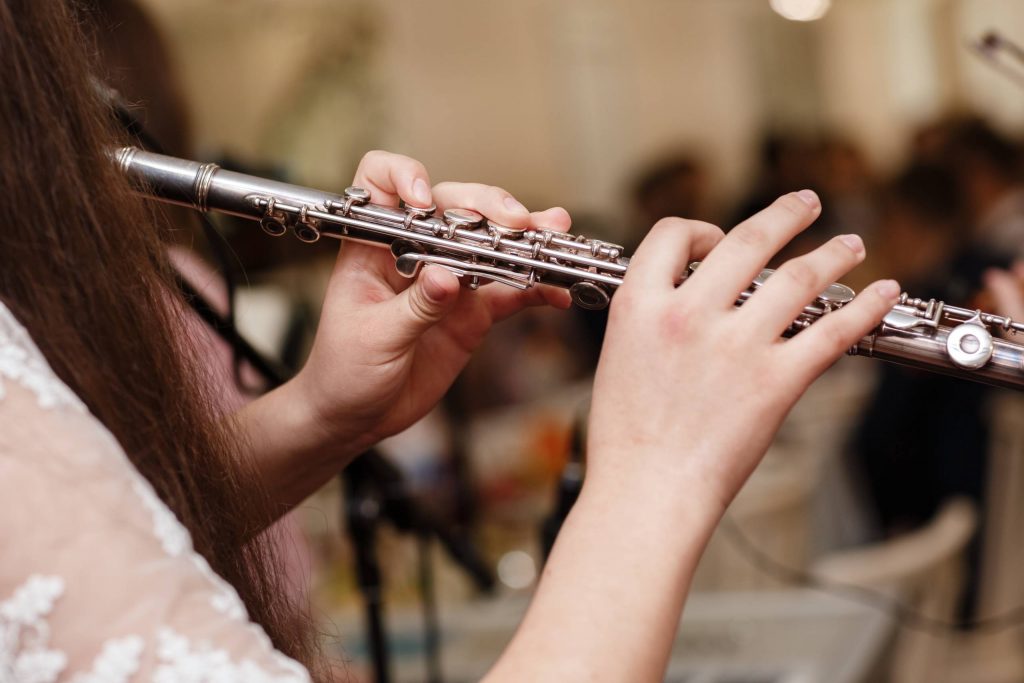
Beyond this, practicing breath control is a good idea for flute players. This is simple — when you practice your flute, take some time to try holding your breath for a few seconds at a time, then release it slowly and resume playing. Do this several times in a row, as this will help you build up your ability to hold your breath for longer periods of time.
Breathing is the basis of flute playing and by managing the airflow, you can create the sound of your dreams. First of all, it is important to understand the airflow and how it works. I often see that a lot of my students are blowing air into the flute, but in reality, the air should “fall” down to the flute. In that way, the sound can become more beautiful and you can control the dynamics better. Usually, I see students who don’t use their diaphragm in order to create better phrasing, and if you practice and work on it, you can create longer phrases. Also, by practicing your breathing, you can learn to adjust the airflow in the different octaves, and it will give you better sound and more facility to play. So it is very important to practice breathing because over time you will have better breath control and better sound.
Later, as students mature, they learn that air support is linked to sound, but also to the amount of air we use affects the phrasing and musicality. When you think of telling a story through a sonata, you can think of taking breaths like you would take pauses in a sentence. Technically, the goal is to breathe in and have the breath reserve necessary to play though ideas without the breathing interupting your ideas. The practice of long tones and scales helps the student feel that the air is in the body, and later learn how to approach the passages that need more air. It takes time and practice, but eventually it becomes automatic to take the breaths and cause the music to breathe as if it were alive, bringing others into the world that you create as a performer.
Common issues with breathing can be tension and postural alignment, both of which can result in poor tone. These issues can be solved by simply being mindful of them in your daily practice, and perhaps beginning with a series of relaxation exercises to loosen any muscles which do not need to be tense. It may be helpful to think of your air support as a long ribbon of silk unrolling smoothly and evenly, because it will not sound as forced or strained as it would if you just blow with great force. Ultimately, becoming a skilled breathing flutist will serve you in many ways, not the least of which is that you will feel much more secure in performance situations when stress might make your breathing tight and irregular. Approach these difficulties as ways to develop your areas of weakness.
Apart from the mechanics, breathing has much to do with the emotional dimension of playing the flute. Like the human voice, the flute can convey subtleties of emotion through the breathing. In fact, many old flutists (such as those in the Baroque period) referred to the breath as the “soul” of the flute, which they used to animate the ornaments and trills. In a similar way, we can try breathing accents to give a modern piece some character and style. This aspect of breathing is fun to play with, for every breath is a conscious decision one makes as an interpretation. Most importantly, this creates an intimate bond between the flute and the player. So as you go ahead with your practice, see where it takes you.
Breath control also plays an important role in the larger story of flute mastery, bridging the physical, intellectual, and musical. For those who focus on it, it can help them feel more fulfilled with their practice, because it enables more music, more playing with others, and, if you can surround yourself with the right community, more feedback to inform your practice. Beyond this, the benefits only increase as we internalize breath control: the excitement of a well-played crescendo, the satisfaction of expressing ourselves, and many others. Breath control is not just something to be learned, it’s something we have to practice for the life of our flutelife.