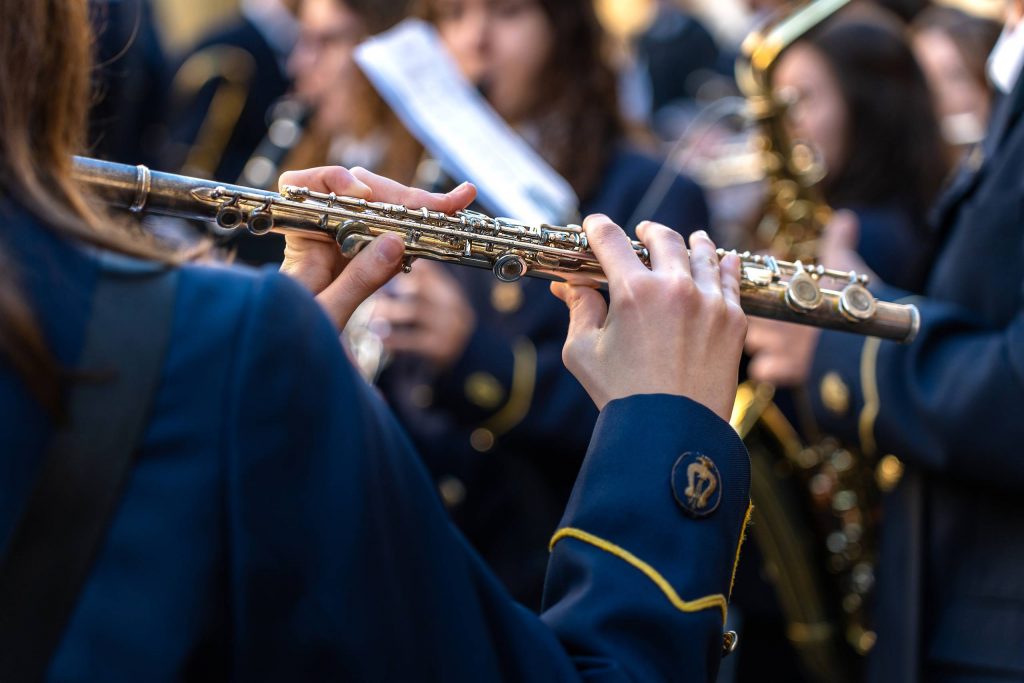
The development of a lovely flute sound is perhaps the most enjoyable and challenging experience of the instrument, one that requires time, attention, and ongoing evolution. Sound begins at the embouchure: the shape and positioning of the lips, which creates an opening through which a defined current of air passes over the blow edge. A well-placed airstream yields a clear and ringing sound without airiness or breathiness, and minute manipulations of the embouchure, jaw, and airstream direction provide limitless tonal coloration. Students often experience an edgy or “weak” sound because they play too aggressively and with an emphasis on the force of the airstream rather than its accuracy. With consistent practice and exploration, the sound blossoms into a rich, full-bodied, and personal sound, laying the groundwork for all subsequent techniques and musicality.
The next difficulty to overcome is an even tone throughout the range of the instrument. Different parts of the instrument’s range require different approaches to the embouchure and air. For example, the low range of the instrument requires a looser embouchure and more relaxed air, yet also a strong diaphragm to prevent the tone from cracking or wavering. Conversely, the upper register of the instrument requires a tighter embouchure and more forceful air stream, both of which require a lighter approach to prevent the tone from becoming sharp or airy. This is accomplished through the practice of long tones in every octave of the instrument, playing each one until a change in the quality of tone is noticed, either sharp or flat. As the player learns to adjust his or her embouchure and air to correct these problems, the notion of what good tone quality is becomes automatic after a few months of practice. This ear-training is just as important as the technical issues with regards to the production of good tone quality.
Vibrato: when your tone is solidified, your vibrato should occur on its own. It should not be so wide as to interfere with the core of your sound, but should enhance your overall sound. A good starting point for flute vibrato is diaphragm vibrato, when you cause the airstream to pulsate in a wave-like fashion. This will cause a slight fluctuation in pitch and dynamics. As your technique becomes more solid, the location of your vibrato will change to your embouchure or a combination of both. The speed and width of your vibrato will depend on the style of music you are playing. A lighter, more narrow vibrato is appropriate for Baroque music, while a fuller, more dramatic vibrato is appropriate for Romantic music. Your vibrato should be used as an expressive tool, rather than a way to disguise issues with your core sound.
A routine of working on the tone every day will go much further toward developing a great sound than any number of one-hour long practice sessions. Performing long tones on one note, then scales and arpeggios as long as you can do them evenly will help you develop your ability to play in tune and develop your tone. Listening back to these exercises will help you identify any habits you don’t notice in your daily routine. Some people use a mirror to keep embouchure placement in line. After awhile, all these habits develop and you have a tone that doesn’t sound forced and carries well in any hall.
Finally, beautiful tone is a reflection of the flutist’s inner musicality and is the means by which she expresses all musical thoughts and feelings. It is not simply a correct way of playing the instrument; it is a distinctive marking that identifies her. Although the development of beautiful tone is a lifelong pursuit for all flutists, even the most advanced, discussion of progress with colleagues provides helpful insight and support as the flutist continually adjusts his or her tone to suit the music being performed, the hall in which it is performed, and his or her own aesthetic development. The flutist who produces the most beautiful sound is the one who plays truthfully, expressing his or her musicality without forcing the sound.