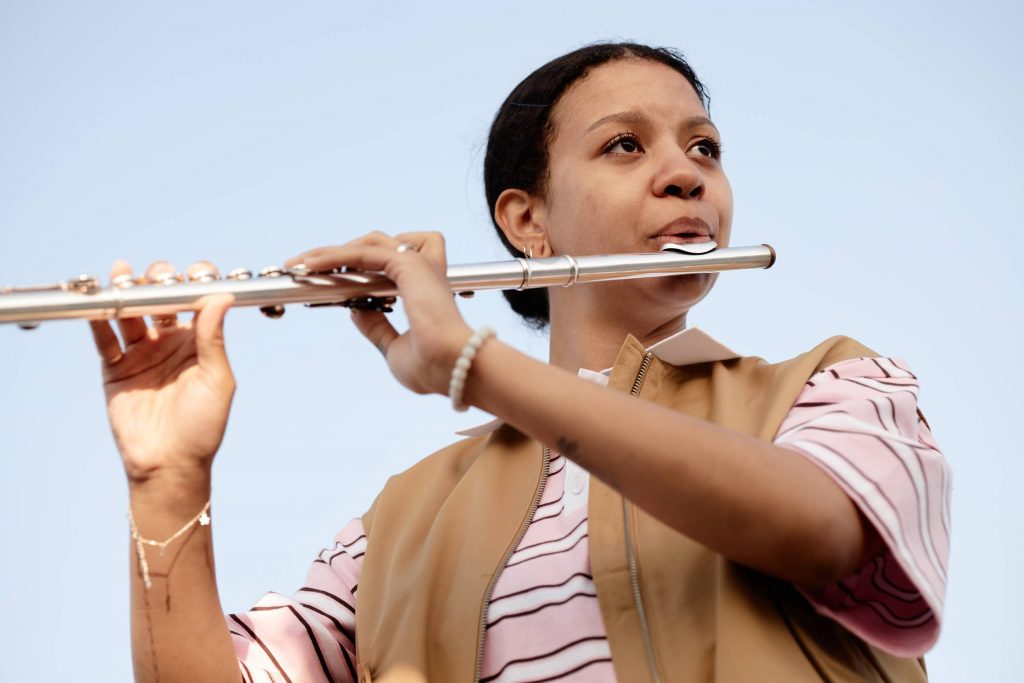
Expression is what separates notes from music. It’s what differentiates the printing press from a novel. When it comes to the flute, the first step to expressive playing is to understand that every note that you play must have a purpose. Whether it be a soft melodic phrase or a loud accented attack, the note should be expressive. The way to convey a musical idea is through phrasing. Phrasing is much like words or sentences in a paragraph. It breaks up long strings of words into groups that make more sense to the listener. You should play each phrase like a wave with a crest and a trough. The wave can be achieved through dynamic (loud and soft) or agogic (long and short) or articulative (smooth and detached) or coloristic (bright and dark) contrasts. Without any phrasing, the most brilliant playing in the world can sound unmusical. With great phrasing, the simplest melodies can be musical.
One of the key components of phrasing is simply to listen and respond to the music’s structure. A crescendo might be in order on an upward scale or decrescendo on a downward scale. Sometimes it’s a good idea to add a breath where one isn’t strictly needed to create dramatic pauses and allow the listener to anticipate the return of the music or to just sit in a moment of silence. I like to practice the extremes of dynamics first so that I can more easily find the true dynamic contrasts within a piece. Eventually it becomes easier to feel the points of tension and release in the music and phrasing seems to take care of itself.
Articulation is an important aspect of personal style, whether one wants to emphasize the differences between long (legato) and short (staccato) or somewhere in between. The tongue is a key factor in defining articulation, but I believe much of the nuance of musicality actually has to do with varying the speed of the air stream and the embouchure. For example, the space between a phrase with a little separation (portato) can evoke softness or indecision, whereas sharp accents can add excitement to the rhythm and drama to the music. Understanding the styles of each period (Baroque tends to use lighter, more differentiated articulations, while Romantic music tends toward a fuller, more connected sound) and playing around with these articulations will help the flutist find their own voice. Even playing the same pieces, you’ll feel like you’re hearing them for the first time.
In addition to volume there are hundreds of other degrees of dynamics to be understood and mastered. The mood in a piece of music can change with a long quiet note or the pizzicato effect of a short one. Long tones can help you become comfortable with swelling dynamics, while applying dynamic control to scales and etudes will help you maintain evenness from one register to the next. Finally, the most musical playing often uses dynamic control within the phrases themselves, to build to a climax or relax back into a decrescendo. This will add another layer of musicality to your playing and help to convey your intent to the listener.
The last important part of playing the flute musically is being able to relate to the music. The relationship is one of allowing the performer to express the emotion of the piece without being overpowered by technic. This should feel somewhat “free,” with some flutists saying that it is as if they let the music flow. The relationship to the music isn’t uncontrolled, as it takes intention and purposeful planning to execute. It is gained by performing frequently (at lessons, concerts, etc.) and getting the response to musical ideas from listeners. Performing for other flutists is a good way to learn how others approach the music and hearing their thoughts and advice will help the flutist realize that interpretation is personal but understandable to all. Finally, the last part of musical playing is the expression. The music and playing should be as natural as speaking, or the ability to feel the heartstrings in the listener.